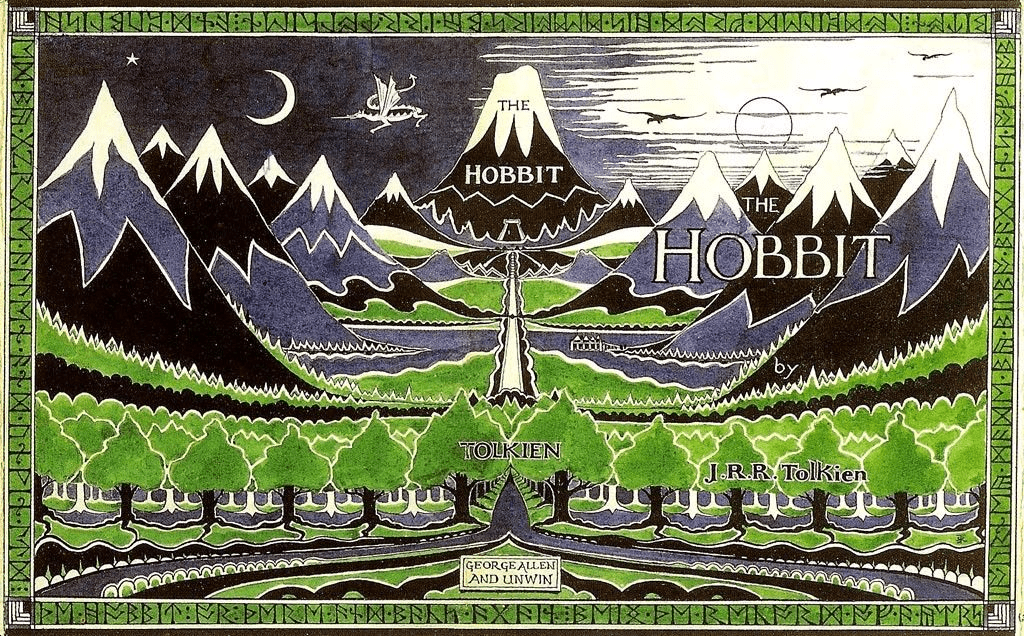
There are a few books that always seem to find their way into translation: The Bible, Le Petit Prince, Grimm’s Fairy Tales, Winnie the Pooh, Harry Potter. Well, today I figured I’d take a crack at one of these which you all might be familiar with: The Hobbit.
I don’t think I’m planning on trying to translate any significant portion of this, but if there’s interest perhaps I might try and do some more pages or even a chapter. Let me know if you’d like to see that!
Without further ado, check out the first page (or so) of J. R. R. Tolkein’s The Hobbit in Chinook (transliterated Chinuk Pipa style):
hobit
chi ar ar tolkin iaka mamuk ukuk siisim
aliks kod iaka mamuk ukuk siisim kopa chinuk
kopa kakwa kikuli haws¹ iaka mitlait, iht tenas man² klaska mamuk nim «hobbit»³.
in a house like a kekuli (traditional pit house) he lived there, a certain ‘small man’ which they call a ‘hobbit’.
Ilo kaltash haws ukuk. ilo patl chok pi ilihi pi worms. ilo wik tlus ham kakwa pus
That wasn’t a no-good house. It wasn’t full of water and earth and worms. There wasn’t a bad smell as if
mitlait tyumach chok kopa win. pi wiht ilo drai pi patl pulali ukuk haws.
there was too much water in the air. And also that house wasn’t dry and filled with dust.
mitlait tlus chir kopa sit dawn pi latam kopa kah iaka makmak. Hobit hol ukuk,
There were good chairs to sit down and a table to eat at. It was a hobbit hole,
kah klaska tlus mitlait.
where they live well.
ukuk haws iaka laport kanawi rawn kakwa windo kopa stimbot, pi grin ukuk,
That home had a door which was entirely round like a window on a steamboat, and it was green,
pi mitlait tlus pil chikmin ikta drit stikom kopa ukuk laport kopa mamuk halak.
And there was a nice copper thing right in the middle of that door for opening it.
pus klaska mamuk halak ukuk laport, klaska nanich rawn oihat
When they open that door, they see a round path
kakwa ukuk rawn oihat kopa main⁴. aias tlus oihat ukuk, ilo smok,
which is like those round paths in mines. It was a very nice path, there was no smoke,
pi laplash kopa wal, mitlait tlus pasisi pi taiil kopa ilihi, aias tlus chir, pi ayu stik kah
and there was planks on the wall, there was nice blankets and tiles on the ground, very nice chairs, and lots of pieces of wood where
klaska mamuk mitlait siapul pi kot: ukuk hobit aias tiki pus tilikom klatwa nanich iaka.
they place their hats and coats: that hobbit really likes people visiting him.
Aias lon ukuk oihat, pi ilo drit kopa ukuk tanas mawntin, kahkah ukuk oihat kuli.
That path was very long, but it didn’t go straight into that hill, that path wandered here and there.
«ukuk tanas mawntin», kakwa klaska mamuk nim, kanawi ukuk tilikom mitlait ayu
‘The Hill”. that’s how they called it, all those people who lived many
mail saia. ayu rawn laport mitlait kopa ukuk oihat.
miles far off. Many round doors were on that path.
Ilip kopa iht said pi iawa wiht kopa iht said.
At first on one side and then also on the other side.
wik kata pus klaska klatwa sahali, ukuk hobit:
They couldn’t go up, those hobbits:
ukuk rum kah klaska slip, kah klaska shit, kah tilikom mamuk mitlait makmak
That room where they sleep, where they go to the bathroom, where they place food
pi wain kikuli kopa haws, kah klaska mamuk mitlait makmak insaid kopa haws (ayu
and wine under the house, where the place food inside the house (there were many
kakwa rum mitlait), kah klaska makmak, kanawi kakwa rum mitlait kopa ilihi pi kopa
such rooms there), where they ate, all such rooms were on the ground and on
ukuk oihat. Ilip tlus rum mitlait kopa lift hand pus maika klatwa insaid.
that path. The best rooms were on the left-hand side if you are going inside.
kopit kopa ukuk rum mitlait windo kanawi rawn kah klaska nanich tlus gardin
Only in these rooms were there windows which were entirely round where they could see a nice garden
pi tlus ilihi tanas saia kikuli, ilo saia kopa stalo.
and meadow a little far off downwards, not far from the river.
ayu iaka iktas ukuk hobit, pi iaka nim bagins.
His things were many that hobbit and his name was Baggins.
drit aias lili ukuk bagins tilikom klaska mitlait ilo saia kopa ukuk tanas mawntin.
For a truly very long time that Baggins family lived not far from that hill.
aias klaska nim pi ilo kopit kopa ukuk klaska iktas: wik kansih klaska kaltash kuli
They were well known and not only for those things of theirs: they never wandered up to no good
pi mamuk hloima mamuk.
and did strange deeds.
pus tilikom askim klaska ikta, kwanisim klaska komtaks ikta klaska kilapai wawa.
If people ask them something, they always know what they will answer.
ukuk siism kata iht bagins iaka kuli saia, pi mamuk aias hloima mamuk.
This story is about how one Baggins traveled far off and did strange deeds.
klunas chako kaltash iaka nim kopa ukuk, pi ayu tlus iaka tolo:
Perhaps his name became bad because of this, but he earned lots of good:
wik lili msaika nanich ikta iaka tlap.
Soon you all will see what he got.
Footnotes
1- “kakwa kikuli haws” is how the traditional pit-house (kekuli) like buildings are talked about in the Chinook Bible History. I could have just said “hol”, but isn’t it just so much more Chinook-y to compare them to kekulis?
2- Again here I could have just said “hobit”, but “tenas man” and “smol man” is how the ‘dwarf beings’ are described by Thomas Paul in Chinook (see Melville Jacobs “Texts in Chinook Jargon” p. 21). It makes it much chinook-ier to talk like this in my mind.
3- This represents writing “Hobbit” in ‘tkop man pipa’ (the alphabet you are reading now), rather than chinuk pipa.
4- This is not a common word, but I have seen it before, for example famously in Slumach’s curse “nika memaloos, mine memaloos”.
 The Kaltash Wawa
Naika tumtum kloshe kopa mamook chako klatawa ukuk siism.
LikeLike